Avainsana: sisäinen motivaatio

  • Intrinsic motivation: the silent multiplier in sales

    By: Severi Suomala

    Published 8.12.2025

    Sales organisations have become exceptionally good at measuring what is easy to measure. Targets, quotas and performance dashboards form the architecture of most commercial cultures, and the assumption often follows that improving these structures will also improve motivation. Yet long-term sales performance rarely maps cleanly onto the size of a commission plan or the aggressiveness of monthly targets. Some individuals thrive across market cycles, industries and products. Others with identical incentive structures rise quickly and then stall. The explanation for this variation lies less in external reward systems and more in the quality of internal motivation that guides how salespeople learn, interpret situations and engage with customers.

    Motivation research has long distinguished between extrinsic and intrinsic forms of regulation. Although the concepts of intrinsic and extrinsic motivation were not new to me, they became far more compelling when I encountered their treatment in The Cambridge Handbook of the Learning Sciences, where motivation is presented as a central driver of curiosity, persistence, and meaningful learning (Sawyer 2022). Extrinsic motivation refers to behaviour conducted for a separable outcome such as a reward or avoidance of punishment. Intrinsic motivation refers to engagement driven by inherent interest, enjoyment or a sense of meaning in the activity itself (Deci & Ryan 1985). This distinction matters for sales, because the work increasingly requires cognitive flexibility, sustained attention, learning in motion and the ability to form authentic relationships with customers. These behaviours tend to flourish when intrinsic motivation is well supported and tend to degrade when the primary source of energy is pressure or external control.

    Why extrinsic pressure is insufficient in complex sales

    In many commercial cultures, the dominant assumption is that more pressure produces more performance. This assumption appears intuitive, yet research repeatedly shows that external rewards have narrowing effects on attention and can undermine creativity and learning. Kohn’s (1993) critique of reward centred systems demonstrates that external incentives often reduce the quality of engagement by encouraging people to prioritise the reward over the learning process, which is a poor fit for work that requires exploration and judgment. Amabile & Kramer’s (2011) research on creativity similarly notes that controlled, high pressure environments tend to diminish intrinsic interest, which subsequently reduces adaptability and problem-solving capacity.

    The MMA Sales and Marketing Professionals union study on wages in 2024 shows that compensation in the field still relies heavily on personal, result-based bonuses, while meaningful indicators such as customer satisfaction remain marginal. For a profession that depends on trust, learning and long-term judgment, the persistence of these extrinsic systems feels increasingly misaligned with established motivation research.

    B2B selling environments amplify these issues. When sales cycles are long, products are complex and customer contexts are dynamic, performance depends on how effectively a salesperson can interpret evolving situations, integrate knowledge, maintain curiosity and build trust. These behaviours do not intensify under high pressure. They intensify when the salesperson experiences a sense of agency, mastery and purpose. Overreliance on external incentives risks producing an outward appearance of activity while gradually eroding the motivational foundation that sustains thoughtful engagement.

    The architecture of intrinsic motivation

    Self determination theory offers a structured explanation for why some environments produce deeper and more durable motivation than others. According to Deci and Ryan, intrinsic motivation is strongest when three central psychological needs are supported: autonomy, competence and relatedness (Deci & Ryan 1985; Deci & Ryan 2017). When individuals experience choice in their work, opportunities to grow their skills and meaningful connection with others, they tend to direct energy toward learning and improvement rather than compliance.

    Pink’s (2009) interpretation of this research frames these three needs in a commercially resonant manner: autonomy, mastery and purpose. This framing is particularly effective for sales because it aligns with the daily realities of the role. Autonomy supports the salesperson’s capacity to choose strategies that fit their strengths. Mastery connects motivation to intentional skill development rather than to outcomes alone. Purpose links the work to a broader contribution, which increases resilience and focus.

    Autonomy as a performance foundation

    Autonomy in sales work is not the absence of structure. It is the experience of being able to exercise professional judgment within a clear framework. Research demonstrates that when people feel they are the origin of their actions, their engagement tends to rise, and they respond more adaptively to new challenges (Deci & Ryan 2017). In sales contexts, autonomy allows individuals to shape conversations, explore customer logic and experiment with approaches. This sense of authoring one’s own work becomes an anchor for intrinsic motivation.

    Mastery and the ongoing development of skill

    Mastery relates to the intrinsic satisfaction of becoming more capable in one’s craft. Csikszentmihalyi’s (2009) work on flow highlights that people enter states of deep absorption when the challenge of a task matches their evolving skill level. These states are typically reported as highly rewarding, not because of external recognition but because the individual feels fully engaged in meaningful activity. In sales work, mastery shows up in the gradual refinement of questioning, the ability to map stakeholder interests or the skill of diagnosing a customer’s real problem, thus providing value. These developmental arcs create an internal reward structure that is more durable than bonuses or contests.

    Purpose and the orientation toward customer impact

    Purpose strengthens intrinsic motivation by connecting daily actions to meaningful outcomes. Research on purpose driven selling demonstrates that salespeople who organise their work around improving the customer’s condition tend to outperform those who focus primarily on meeting internal metrics (McLeod & Lotardo 2020). Purpose shifts attention away from transactional thinking and toward understanding, empathy and long-term value creation. This orientation increases motivation and elevates the quality of customer relationships.

    How intrinsic motivation changes behaviour in sales practice

    Intrinsic motivation influences how much energy a salesperson invests in their work and shapes the character of that energy. Individuals who are driven by curiosity and purpose tend to approach situations with broader attentional bandwidth and are more willing to explore alternative interpretations. Adam Grant’s (2016) work in Originals illustrates that intrinsically motivated individuals are more likely to challenge conventions, rethink assumptions and propose novel approaches. In sales, this becomes visible in how people learn new industries, examine customer contexts and adjust their strategies during complex negotiations.

    Additionally, intrinsic motivation enhances relational quality. Customers quickly detect whether a salesperson is motivated by genuine interest or by the need to close a transaction. When motivation is anchored in purpose and mastery, interactions become more exploratory and less pressured. Over time, this dynamic produces trust and deeper engagement. Research on meaningful work and progress further reinforces this point. Amabile & Kramer (2011) found that even small signs of meaningful progress create emotional uplift that fuels sustained performance. When salespeople feel that they are genuinely helping customers move forward, their motivation becomes self reinforcing.

    Conditions that strengthen intrinsic motivation in sales teams

    Leaders cannot manufacture intrinsic motivation, but they can construct environments where it emerges more naturally. Several principles from motivation research translate directly into sales leadership practice.

    First, autonomy supportive leadership is essential. This requires reducing unnecessary control, providing clear rationales for decisions and inviting input into methods rather than prescribing all steps. Deci and Ryan (2017) note that such environments increase internalisation and engagement because they support the psychological need for self determination.

    Second, focus on learning and mastery should be deliberately cultivated. Progress conversations, skill focused coaching and reflective practices align well with Amabile & Kramer’s (2011) findings on the energising effect of meaningful progress. When leaders recognise development rather than only evaluating outcomes, they reinforce internal drive.

    Third, a shared sense of purpose must be actively maintained. McLeod & Lotardo’s (2020) research shows that purpose becomes a commercial advantage when it shapes daily decisions rather than appearing only in mission statements. Leaders who draw attention to customer impact, discuss value creation and highlight stories of improvement help anchor motivation in meaning.

    Finally, organisations should be careful with the architecture of reward systems. Kohn’s (1993) critique of excessive rewards is relevant here. When incentives are used as the primary motivational tool, they risk crowding out intrinsic interest by signalling that the behaviour is not inherently valuable. Rewards should confirm excellence, not substitute for the intrinsic value of the work.

    Intrinsic motivation as a long-term performance asset

    Intrinsic motivation functions as a silent multiplier because it strengthens the underlying mechanisms that sustain learning, adaptability and trust. When salespeople experience autonomy, develop mastery and connect their work to purpose, their motivation becomes less dependent on external pressure and more aligned with the inherent demands of complex selling. This deeper form of engagement produces better conversations, better decisions and better customer outcomes. It also supports resilience, because motivation is no longer tied only to the last won or lost deal but to the ongoing experience of doing meaningful work.

    For organisations that rely on skilled commercial teams, cultivating intrinsic motivation is not a soft concept. It is a strategic requirement. External incentives may initiate movement, but internal motivation determines its direction and durability. By shaping environments that support autonomy, mastery and purpose, leaders strengthen the motivational architecture that allows salespeople to perform at a high level across industries, cycles and conditions. The quiet nature of intrinsic motivation makes it easy to overlook, yet it is precisely this quietness that gives it its compounding power.

    Something to think about:

    1. If external rewards disappeared tomorrow, which behaviours in sales would actually stay in place, and what would that reveal about how motivation really works in our organisations?

    2. Which part of your work feels most intrinsically motivating today, and what would change in your performance if that feeling showed up more often?

    3. Why do you think so many sales cultures still default to pressure and incentives, even when evidence shows that autonomy, mastery and purpose produce stronger long-term results?

    References

    Amabile, T & Kramer, S. 2011. The progress principle: Using small wins to ignite joy, engagement, and creativity at work. Harvard Business Review Press, Boston.

    Csikszentmihalyi, M. 2009. Flow: The psychology of optimal experience. Harper Perennial, New York.

    Deci, EL & Ryan, R. 1985. Intrinsic motivation and self-determination in human behavior. Plenum Press, New York.

    Deci, EL & Ryan, R. 2017. Self-determination theory: Basic psychological needs in motivation, development, and wellness. Guilford Press, New York.

    Grant, A. 2016. Originals: How non-conformists move the world. Viking Press, New York.

    Kohn, A. 1993. Punished by rewards: The trouble with gold stars, incentive plans, A’s, praise, and other bribes. Houghton Mifflin, Boston.

    McLeod, L & Lotardo, E. 2020. Selling with noble purpose: How to drive revenue and do work that makes you proud. 2nd ed. Wiley, Hoboken.

    MMA. 2025. Myynti- ja markkinointialan palkat 2024: tiivistelmä keskeisistä löydöksistä. Myynnin ja Markkinoinnin Ammattilaiset. Accessed: 22.11.2025. Available at: https://mma.fi/ajankohtaista/artikkelit/mman-palkkatutkimus-neuvottelu-kannattaa-mutta-kaikki-eivat-sita-hyodynna/#lataa

    Pink, D. 2009. Drive: The surprising truth about what motivates us. Riverhead Books, New York.

    Sawyer, R., et.al. 2022. The Cambridge handbook of the learning sciences. 3rd ed. Cambridge University Press, Cambridge.
  • Coaching curiosity at scale

    By: Severi Suomala

    Published: 1.11.2025

    The curiosity gap

    Curiosity has become one of the most admired yet least cultivated capacities in modern organisations. Surveys repeatedly show that while leaders champion curiosity in principle, they rarely protect or reward it in practice. The Mercer Global Talent Trends 2024–2025 report confirms that only a minority of organisations are intentionally designing for learning and reflection, even though employees who experience trust and openness report far higher energy, thriving, and retention.

    Francesca Gino’s (2018) findings that only one in four employees feel encouraged to ask questions mirror this pattern, the desire to learn exists, but the system suppresses it. Efficiency and certainty dominate, leaving little room for inquiry. In many teams I have observed, curiosity erodes quietly under the weight of deadlines and optimisation. What begins as a culture of exploration turns into a culture of replication. “We followed this path to close a deal last month, replicate it.”

    Sustaining curiosity therefore requires design, not motivation. Ian Leslie (2014) describes curiosity as a “mental muscle that atrophies without exercise.” When processes and habits fail to stretch it, the organisational mind grows rigid. Leaders who recognise this treat curiosity as a renewable resource that needs deliberate maintenance, not as a personality trait.

    From individual spark to collective design

    Leslie (2014) argues that curiosity flourishes when uncertainty meets structure. Too much ambiguity creates anxiety, too little creates boredom. The same balance applies to organisations. Adam Grant (2021) calls this balance “thinking again,” the disciplined act of questioning one’s own assumptions while remaining anchored in purpose. Teams that institutionalise this mindset stay adaptive even when external change accelerates.

    Satya Nadella (2017) demonstrated this principle by turning Microsoft from a “know-it-all” to a “learn-it-all” culture. His method was systematic: company-wide growth-mindset sessions, hackathons that encouraged experimentation, and protected time for side projects. These routines shifted behaviour because they built learning into the company’s operating rhythm. Curiosity was no longer dependent on enthusiasm, it became a professional expectation.

    Turning individual curiosity into a collective strength requires visible and invisible design. Visible design includes rituals such as reflection sessions, peer learning circles, and forums for unfinished ideas. Invisible design lies in language. When leaders respond to questions with genuine interest rather than defensiveness, they legitimise uncertainty. Each small interaction signals that curiosity is part of how success is defined.

    Designing the environment

    Learning rarely emerges by accident. In The Cambridge Handbook of the Learning Sciences, Sadhana Puntambekar and Clark A. Chinn (2022) explain that learning scientists investigate how people construct knowledge and “use this scholarship to design new routines, tools, and curricula to improve learning.” Their work shows that effective learning environments are intentionally designed to promote reflection, collaboration, and iterative experimentation. When similar structures are applied to corporate systems, regular feedback, shared inquiry, and protected time for reflection, curiosity becomes self-reinforcing rather than sporadic.

    Many organisations still attempt to graft curiosity onto frameworks built for control. These systems value prediction and compliance, not discovery. The result is a performance culture that rewards certainty and punishes exploration. Mercer (2024) highlights that resilient organisations balance empathy with economics and delegate decisions locally, allowing experimentation without losing alignment. Those structures create the space where curiosity can translate into innovation.

    Leaders who wish to redesign for curiosity can begin with small structural changes. Meetings can include check-out rounds that capture what was learned, not just what was delivered. Reviews can highlight insights as well as outcomes. Even short reflective pauses build the muscle that Leslie (2014) describes. Curiosity then becomes a behavioural expectation embedded in how work gets done.

    Coaching curiosity as habit

    Stanier (2016) argues that effective leadership begins with “staying curious a little longer.” His coaching method replaces habitual advice-giving with habitual questioning. Questions such as “What’s the real challenge here for you?” or “What else might be true?” invite thinking rather than compliance. Over time, these conversational shifts develop a culture of inquiry where learning happens through dialogue.

    At Microsoft, Nadella’s (2017) leadership meetings often started with questions rather than reports. He listened for insight instead of status. The practice spread because it was consistent. Repetition turned curiosity into habit. Similarly, when managers integrate open questioning into weekly one-on-ones, they model that reflection is part of performance, not a distraction from it.

    Habits scale curiosity more reliably than slogans. When every manager is expected to coach rather than instruct, curiosity becomes self-propagating. As Stanier (2016) points out, managers who adopt a coaching mindset “work less hard and have more impact” precisely because their teams learn to think independently.

    Safety before exploration

    Edmondson (1999) established that psychological safety is the foundation of team learning. People speak up and experiment only when they believe mistakes will not be punished. Adam Grant (2021) reinforces this link, writing that a learning culture rests on respect, trust, and openness. When leaders create these conditions, curiosity stops being a risk and becomes a contribution.

    Scott Shigeoka (2023) shows that leaders who admit uncertainty appear more approachable and that humility correlates with lower burnout and higher creativity. The same pattern appears in Mercer’s (2024) data: trust and equity are the strongest variables predicting energy and thriving. The implication is clear, psychological safety is not a soft issue, it is the precondition for innovation.

    Leaders can reinforce safety through simple responses. Phrases such as “That’s worth exploring” or “Tell me more” communicate respect for inquiry. Over time these micro-signals accumulate into a social contract: curiosity is welcome here. Without such reinforcement, even well-designed systems decay into silence.

    Balancing curiosity and clarity

    Grant (2021) observes that conviction and flexibility are not opposites but complementary. Clarity of purpose provides the boundaries within which curiosity operates. Too much freedom disperses effort; too much control suppresses learning. Effective leaders maintain clarity on outcomes while leaving method open to exploration.

    Curiosity also demands endurance. Leslie (2014) reminds us that the urge to close questions prematurely is one of its greatest obstacles. Staying curious requires patience and tolerance for ambiguity. Leaders can institutionalise this discipline by making reflection measurable through learning goals, after-action reviews, or recognition for insightful questions. When curiosity is measured, it gains legitimacy alongside traditional performance indicators.

    In my own experience, the most adaptive teams are those that treat clarity and curiosity as partners. They know where they are going but remain alert to what they might discover on the way. The interplay between purpose and exploration becomes the engine of progress.

    Practical architecture

    Curiosity can be cultivated across three reinforcing layers.

    At the personal level, individuals can set aside short intervals each week for deliberate reflection. Grant (2021) describes leaders who carry cards listing questions they must ask before major decisions, a reminder that inquiry should precede action. Such routines protect learning from the tyranny of urgency.

    At the team level, rituals sustain shared learning. Regular “what surprised us?” sessions or curiosity challenges invite members to surface insights that do not fit established narratives. When feedback loops emphasise discovery, teams maintain energy even in demanding times.

    At the organisational level, structure determines scale. Cross-functional projects, rotational assignments, and recognition for experimentation all communicate that learning is work. The Mercer (2024) report notes that resilient organisations balance empathy and economics and make key decisions locally, fostering autonomy and exploration. Nadella (2017) achieved this through Microsoft’s hackathons and learning weeks, visible proof that curiosity had executive sponsorship.

    Curiosity as shared infrastructure

    Curiosity cannot depend on individual enthusiasm, it must live within systems. Once embedded, it becomes infrastructure, connecting people through shared inquiry and adaptive feedback loops. Hoadley, C describes in The Cambridge Handbook of the Learning Sciences (Sawyer, 2022) learning communities as networks where knowledge circulates freely and innovation becomes collective rather than episodic. The same principle applies to companies that build curiosity into routines rather than slogans.

    Every open question asked in good faith strengthens this infrastructure. Curiosity spreads through conversation, not instruction. When leaders protect time to think and reward the courage to ask, they institutionalise adaptability. In an era when information changes faster than experience accumulates, curiosity is not decoration and pretty words; it is survival.

    Exercises and reflections

    1. Replace one directive with a question. In your next meeting, reframe one instruction for a genuine inquiry and observe the change in tone.
    2. Make learning visible. End every project with “What did we learn?” to transform output into reflection.
    3. Redesign one process. Find a routine that discourages questioning and rebuild it to include exploration time.
    4. Track curiosity. Count how many questions you and your team ask in a week, then discuss what that number says about culture.

    References

    Bungay Stanier, M. 2016. The Coaching Habit: Say Less, Ask More and Change the Way You Lead Forever. Box of Crayons Press, Toronto.

    Edmondson, A. 1999. Psychological Safety and Learning Behavior in Work Teams. Administrative Science Quarterly, 44(2). Available at: https://web.mit.edu/curhan/www/docs/Articles/15341_Readings/Group_Performance/Edmondson%20Psychological%20safety.pdf   Accessed: 12.10.2025

    Gino, F. 2018. The Business Case for Curiosity. Harvard Business Review. Available at: https://hbr.org/2018/09/the-business-case-for-curiosity Accessed: 04.10.2025

    Grant, A. 2021. Think Again: The Power of Knowing What You Don’t Know. Penguin Random House, New York.

    Leslie, I. 2014. Curious: The Desire to Know and Why Your Future Depends on It. Basic Books, New York.

    Mehta, S. 2024. Satya Nadella’s 3-word description of Microsoft’s culture should inspire leaders to be learners. Fast Company. Available at: https://www.fastcompany.com/91133383/microsoft-ceo-satya-nadella-3-word-description-microsoft-culture-leadership Accessed: 22.10.2025

    Mercer. 2024. Global Talent Trends Report 2024. Report. Available at: https://www.mercer.com/insights/people-strategy/future-of-work/global-talent-trends/    Accessed: 07.10.2025

    Nadella, S. 2017. Hit Refresh: The Quest to Rediscover Microsoft’s Soul and Imagine a Better Future for Everyone. HarperCollins, London.

    Sawyer, R. K., et al. 2022. The Cambridge Handbook of the Learning Sciences. 3rd edn. Cambridge University Press, Cambridge.

    Shigeoka, S. 2023. 4 Phrases That Build a Culture of Curiosity. Harvard Business Review. Available at: https://hbr.org/2023/11/4-phrases-that-build-a-culture-of-curiosity Accessed: 18.10.2025

    Walsh, D. 2022. How to Boost Curiosity in Your Company – and Why. Article. Available at: https://mitsloan.mit.edu/ideas-made-to-matter/how-to-boost-curiosity-your-company-and-why Accessed: 26.10.2025

  • Why curiosity outlasts experience in sales

    By Severi Suomala

    Published 30.09.2025

    Experience gave me my first promotion. Curiosity gave me the rest.

    I have worked in insurance, SaaS, and security, not exactly a straight and obvious career path. Each time, experience helped me get started. It gave me the context to step into a new role and know which way was up. But what really carried me forward was curiosity: asking the extra questions, figuring out what made customers tick, and refusing to accept “that’s how we’ve always done it” as an answer.

    That is the real difference. Experience gives perspective. Curiosity keeps you moving.

    Why curiosity matters more than background

    If sales were only about what you already know, most of us would be out of work by now. Products change, markets shift, and customers raise questions that never appeared in last year’s onboarding slides. Experience offers useful context, but it comes with a “best before” date. Learning sciences distinguish between routine expertise, performing known tasks, and adaptive expertise, which allows transfer of knowledge and strategies into new situations (Sawyer 2022, 92–94). In sales, adaptive expertise is the one that lasts.

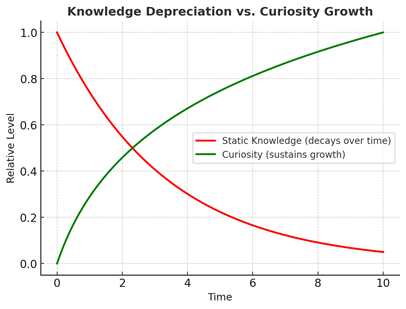
    Curiosity fuels adaptability. It drives people to ask “why” when others stop. Research shows curiosity sustains learning even when other motivators fade (Sawyer 2022, 609–613). Leslie (2014, 63–65) calls it a compounding asset: static knowledge decays, while curiosity generates fresh insights.

    Figure 1. Knowledge depreciation vs. curiosity growth as explained by Leslie (2014).

    Practice supports this. Mark Roberge found that curiosity and coachability predicted sales success more reliably than aggression or prior industry knowledge (Roberge 2015, 34–36). Jill Konrath (2014, 20–34) highlights agility, the speed of learning, as the ultimate differentiator. Adam Grant (2021, 23–25) warns that intelligence without rethinking can trap us in assumptions, whereas curiosity helps us update and adapt.

    In short, experience teaches how to win in the past. Curiosity shows how to win in the future.

    Curiosity as behaviour, not trait

    Curiosity is often seen as a personality trait, but research shows it is a behaviour that can be practiced and improved. Reflection and self-regulation encourage people to identify gaps in their knowledge, sustaining curiosity over time (Sawyer 2022, 92–94; 609–613). Warren Berger (2014, 31–33) describes questioning as a discipline that comes from deliberate practice, not accidents.

    Leadership plays a role too. Stanier (2016, 153–155) shows managers can coach curiosity by asking reflective, open-ended questions instead of giving quick answers. Nick Kane (2019) calls curiosity the most underappreciated sales trait, often overlooked in favour of training or activity metrics. George Brontén (2021) adds that while some seem naturally inquisitive, curiosity can become team culture if leaders reward learning, encourage deeper questioning, and model genuine interest.

    How to cultivate curiosity in teams

    Curiosity thrives when reflection and inquiry are built into daily routines. People and teams that pause to assess what they’ve learned, where gaps remain, and what strategies worked best develop habits that sustain curiosity (Sawyer 2022, 93–106; 134–139).

    Practical sales work shows this as well. Berger (2014, 148) notes that environments which reward questioning, not just quick answers, cultivate curiosity. Stanier (2016, 137) explains how managers can turn interactions into “learning loops.” Dani Jones (2024) suggests using learning logs, role-plays, and thorough pre-call research to embed curiosity-driven sales. Ryan Walsh (2023) reframes “Always Be Closing” as “Always Be Curious,” reflecting a shift toward engagement over pressure.

    Konrath (2014, 25) stresses agility as today’s decisive skill, making onboarding more about accelerating learning habits than delivering product knowledge. Brontén (2021) emphasizes that culture cements curiosity into practice. Just as athletes drill reflexes, salespeople can train curiosity until it becomes automatic.

    Curiosity as trust-builder and risk-reducer

    Trust is the real currency of sales. Curiosity accelerates it by showing genuine interest in the customer’s world. Dale Carnegie (2020, 49–52) argued that goodwill comes from genuine interest in others. Cialdini (2009, 167) confirms reciprocity and listening build influence.

    Research shows curiosity sustains motivation and engagement, strengthening connections (Sawyer 2022, 602–613). In sales, this means customers feel heard and valued, lowering perceived risk. Bob Marsh (2025) notes curiosity-driven questioning often turns sceptical prospects into engaged customers. Frances Frei (2018) identifies authenticity, logic, and empathy as the three pillars of trust, all reinforced by curiosity. Brontén (2021) adds that curiosity makes buyers see the salesperson as a partner solving problems, not just pushing transactions.

    Where we have been, where we are going

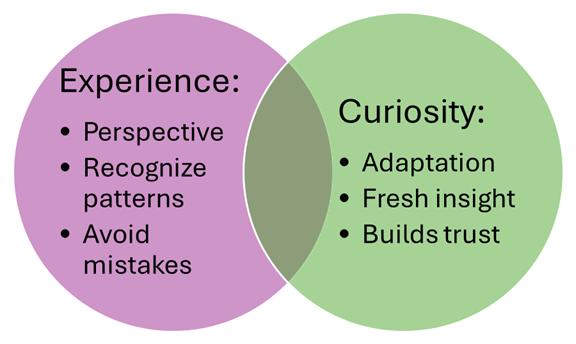
    Experience is like a receipt for what you have seen. Curiosity is a ticket for what you have yet to discover. Both matter, but they play different, complementary roles.

    Figure 2. Complementary roles of Experience and Curiosity.

    Experience offers perspective. It helps us recognize patterns and avoid old mistakes. Curiosity ensures those patterns do not become blinders. It pushes us to keep learning, to ask the questions others stopped asking, and to adapt when markets shift.

    The real challenge for leaders is not to choose between curiosity and experience, but to balance them. Experience tells us where we have been. Curiosity shows us where we are going. The organizations that thrive will be the ones that know how to invest in both.


    I’ll leave you with a few questions:

    • How have you fed curiosity in your own work or team?
    • When has curiosity helped you win trust with a customer?
    • If you hire or lead salespeople, how do you spot curiosity in candidates or coach it in your team?

    If these ideas spark something for you, I’d love to hear about it. Feel free to reach out, whether you want to swap stories, discuss how to build curiosity into sales, or try out some practical exercises.

    References
    Berger, W. 2014. A More Beautiful Question: The Power of Inquiry to Spark Breakthrough Ideas. New York: Bloomsbury.

    Brontén, G. 2021. A More Curious Sales Team is a More Successful Sales Team. Membrain Blog. Available at: https://www.membrain.com/blog/a-more-curious-sales-team-is-a-more-successful-sales-team [Accessed 10 September 2025].

    Carnegie, D. 2020. How to Win Friends and Influence People. 1st ed. New Delhi: Orange Books International.

    Cialdini, R. B. 2009. Influence: The Psychology of Persuasion. New York: HarperCollins.

    Frei, F. 2018. How to Build (and Rebuild) Trust. TED Talk. Available at: https://www.ted.com/talks/frances_frei_how_to_build_and_rebuild_trust [Accessed 10 September 2025].

    Grant, A. 2021. Think Again: The Power of Knowing What You Don’t Know. New York: Penguin Random House.

    Jones, D. 2024. Curiosity-Driven Sales: How to Build Stronger Customer Connections. TL;DV Blog. Available at: https://tldv.io/blog/curiosity-driven-sales [Accessed 11 September 2025].

    Kane, N. 2019. Curiosity is Sales’ Unsung, Important Personality Trait. Janek Performance Group Blog. Available at: https://www.janek.com/blog/curiosity-is-sales-unsung-important-personality-trait [Accessed 12 September 2025].

    Konrath, J. 2014. Agile Selling: Get Up to Speed Quickly in Today’s Ever-Changing Sales World. New York: Portfolio/Penguin.

    Leslie, I. 2014. Curious: The Desire to Know and Why Your Future Depends On It. New York: Basic Books.

    Marsh, B. 2025. Sales Blog. Available at: https://meetbobmarsh.com/blogs/ [Accessed 12 September 2025]

    Roberge, M. 2015. The Sales Acceleration Formula: Using Data, Technology, and Inbound Selling to Go from $0 to $100 Million. Hoboken: Wiley.

    Sawyer, R. K., et.al. 2022. The Cambridge Handbook of the Learning Sciences. 3rd ed. Cambridge: Cambridge University Press.

    Stanier, M. B. 2016. The Coaching Habit: Say Less, Ask More & Change the Way You Lead Forever. Toronto: Box of Crayons Press.

    Walsh, R. 2023. Always Be Curious: The New Sales Mindset. RepVue Blog. Available at: https://www.repvue.com/blog/always-be-curious [Accessed 11 September 2025].