By: Severi Suomala
Published: 1.11.2025
The curiosity gap
Curiosity has become one of the most admired yet least cultivated capacities in modern organisations. Surveys repeatedly show that while leaders champion curiosity in principle, they rarely protect or reward it in practice. The Mercer Global Talent Trends 2024–2025 report confirms that only a minority of organisations are intentionally designing for learning and reflection, even though employees who experience trust and openness report far higher energy, thriving, and retention.
Francesca Gino’s (2018) findings that only one in four employees feel encouraged to ask questions mirror this pattern, the desire to learn exists, but the system suppresses it. Efficiency and certainty dominate, leaving little room for inquiry. In many teams I have observed, curiosity erodes quietly under the weight of deadlines and optimisation. What begins as a culture of exploration turns into a culture of replication. “We followed this path to close a deal last month, replicate it.”
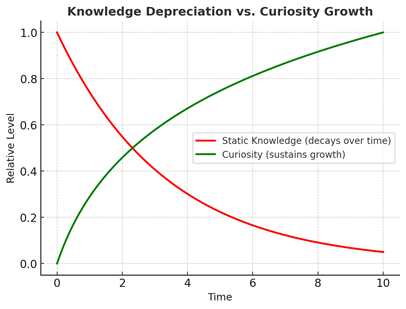
Sustaining curiosity therefore requires design, not motivation. Ian Leslie (2014) describes curiosity as a “mental muscle that atrophies without exercise.” When processes and habits fail to stretch it, the organisational mind grows rigid. Leaders who recognise this treat curiosity as a renewable resource that needs deliberate maintenance, not as a personality trait.
From individual spark to collective design
Leslie (2014) argues that curiosity flourishes when uncertainty meets structure. Too much ambiguity creates anxiety, too little creates boredom. The same balance applies to organisations. Adam Grant (2021) calls this balance “thinking again,” the disciplined act of questioning one’s own assumptions while remaining anchored in purpose. Teams that institutionalise this mindset stay adaptive even when external change accelerates.
Satya Nadella (2017) demonstrated this principle by turning Microsoft from a “know-it-all” to a “learn-it-all” culture. His method was systematic: company-wide growth-mindset sessions, hackathons that encouraged experimentation, and protected time for side projects. These routines shifted behaviour because they built learning into the company’s operating rhythm. Curiosity was no longer dependent on enthusiasm, it became a professional expectation.
Turning individual curiosity into a collective strength requires visible and invisible design. Visible design includes rituals such as reflection sessions, peer learning circles, and forums for unfinished ideas. Invisible design lies in language. When leaders respond to questions with genuine interest rather than defensiveness, they legitimise uncertainty. Each small interaction signals that curiosity is part of how success is defined.
Designing the environment
Learning rarely emerges by accident. In The Cambridge Handbook of the Learning Sciences, Sadhana Puntambekar and Clark A. Chinn (2022) explain that learning scientists investigate how people construct knowledge and “use this scholarship to design new routines, tools, and curricula to improve learning.” Their work shows that effective learning environments are intentionally designed to promote reflection, collaboration, and iterative experimentation. When similar structures are applied to corporate systems, regular feedback, shared inquiry, and protected time for reflection, curiosity becomes self-reinforcing rather than sporadic.
Many organisations still attempt to graft curiosity onto frameworks built for control. These systems value prediction and compliance, not discovery. The result is a performance culture that rewards certainty and punishes exploration. Mercer (2024) highlights that resilient organisations balance empathy with economics and delegate decisions locally, allowing experimentation without losing alignment. Those structures create the space where curiosity can translate into innovation.
Leaders who wish to redesign for curiosity can begin with small structural changes. Meetings can include check-out rounds that capture what was learned, not just what was delivered. Reviews can highlight insights as well as outcomes. Even short reflective pauses build the muscle that Leslie (2014) describes. Curiosity then becomes a behavioural expectation embedded in how work gets done.
Coaching curiosity as habit
Stanier (2016) argues that effective leadership begins with “staying curious a little longer.” His coaching method replaces habitual advice-giving with habitual questioning. Questions such as “What’s the real challenge here for you?” or “What else might be true?” invite thinking rather than compliance. Over time, these conversational shifts develop a culture of inquiry where learning happens through dialogue.
At Microsoft, Nadella’s (2017) leadership meetings often started with questions rather than reports. He listened for insight instead of status. The practice spread because it was consistent. Repetition turned curiosity into habit. Similarly, when managers integrate open questioning into weekly one-on-ones, they model that reflection is part of performance, not a distraction from it.
Habits scale curiosity more reliably than slogans. When every manager is expected to coach rather than instruct, curiosity becomes self-propagating. As Stanier (2016) points out, managers who adopt a coaching mindset “work less hard and have more impact” precisely because their teams learn to think independently.
Safety before exploration
Edmondson (1999) established that psychological safety is the foundation of team learning. People speak up and experiment only when they believe mistakes will not be punished. Adam Grant (2021) reinforces this link, writing that a learning culture rests on respect, trust, and openness. When leaders create these conditions, curiosity stops being a risk and becomes a contribution.
Scott Shigeoka (2023) shows that leaders who admit uncertainty appear more approachable and that humility correlates with lower burnout and higher creativity. The same pattern appears in Mercer’s (2024) data: trust and equity are the strongest variables predicting energy and thriving. The implication is clear, psychological safety is not a soft issue, it is the precondition for innovation.
Leaders can reinforce safety through simple responses. Phrases such as “That’s worth exploring” or “Tell me more” communicate respect for inquiry. Over time these micro-signals accumulate into a social contract: curiosity is welcome here. Without such reinforcement, even well-designed systems decay into silence.
Balancing curiosity and clarity
Grant (2021) observes that conviction and flexibility are not opposites but complementary. Clarity of purpose provides the boundaries within which curiosity operates. Too much freedom disperses effort; too much control suppresses learning. Effective leaders maintain clarity on outcomes while leaving method open to exploration.
Curiosity also demands endurance. Leslie (2014) reminds us that the urge to close questions prematurely is one of its greatest obstacles. Staying curious requires patience and tolerance for ambiguity. Leaders can institutionalise this discipline by making reflection measurable through learning goals, after-action reviews, or recognition for insightful questions. When curiosity is measured, it gains legitimacy alongside traditional performance indicators.
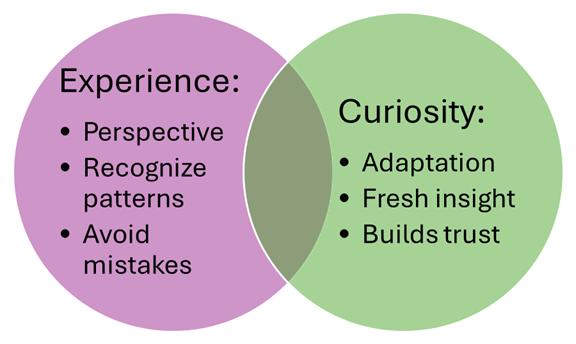
In my own experience, the most adaptive teams are those that treat clarity and curiosity as partners. They know where they are going but remain alert to what they might discover on the way. The interplay between purpose and exploration becomes the engine of progress.
Practical architecture
Curiosity can be cultivated across three reinforcing layers.
At the personal level, individuals can set aside short intervals each week for deliberate reflection. Grant (2021) describes leaders who carry cards listing questions they must ask before major decisions, a reminder that inquiry should precede action. Such routines protect learning from the tyranny of urgency.
At the team level, rituals sustain shared learning. Regular “what surprised us?” sessions or curiosity challenges invite members to surface insights that do not fit established narratives. When feedback loops emphasise discovery, teams maintain energy even in demanding times.
At the organisational level, structure determines scale. Cross-functional projects, rotational assignments, and recognition for experimentation all communicate that learning is work. The Mercer (2024) report notes that resilient organisations balance empathy and economics and make key decisions locally, fostering autonomy and exploration. Nadella (2017) achieved this through Microsoft’s hackathons and learning weeks, visible proof that curiosity had executive sponsorship.
Curiosity as shared infrastructure
Curiosity cannot depend on individual enthusiasm, it must live within systems. Once embedded, it becomes infrastructure, connecting people through shared inquiry and adaptive feedback loops. Hoadley, C describes in The Cambridge Handbook of the Learning Sciences (Sawyer, 2022) learning communities as networks where knowledge circulates freely and innovation becomes collective rather than episodic. The same principle applies to companies that build curiosity into routines rather than slogans.
Every open question asked in good faith strengthens this infrastructure. Curiosity spreads through conversation, not instruction. When leaders protect time to think and reward the courage to ask, they institutionalise adaptability. In an era when information changes faster than experience accumulates, curiosity is not decoration and pretty words; it is survival.
Exercises and reflections
- Replace one directive with a question. In your next meeting, reframe one instruction for a genuine inquiry and observe the change in tone.
- Make learning visible. End every project with “What did we learn?” to transform output into reflection.
- Redesign one process. Find a routine that discourages questioning and rebuild it to include exploration time.
- Track curiosity. Count how many questions you and your team ask in a week, then discuss what that number says about culture.
References
Bungay Stanier, M. 2016. The Coaching Habit: Say Less, Ask More and Change the Way You Lead Forever. Box of Crayons Press, Toronto.
Edmondson, A. 1999. Psychological Safety and Learning Behavior in Work Teams. Administrative Science Quarterly, 44(2). Available at: https://web.mit.edu/curhan/www/docs/Articles/15341_Readings/Group_Performance/Edmondson%20Psychological%20safety.pdf Accessed: 12.10.2025
Gino, F. 2018. The Business Case for Curiosity. Harvard Business Review. Available at: https://hbr.org/2018/09/the-business-case-for-curiosity Accessed: 04.10.2025
Grant, A. 2021. Think Again: The Power of Knowing What You Don’t Know. Penguin Random House, New York.
Leslie, I. 2014. Curious: The Desire to Know and Why Your Future Depends on It. Basic Books, New York.
Mehta, S. 2024. Satya Nadella’s 3-word description of Microsoft’s culture should inspire leaders to be learners. Fast Company. Available at: https://www.fastcompany.com/91133383/microsoft-ceo-satya-nadella-3-word-description-microsoft-culture-leadership Accessed: 22.10.2025
Mercer. 2024. Global Talent Trends Report 2024. Report. Available at: https://www.mercer.com/insights/people-strategy/future-of-work/global-talent-trends/ Accessed: 07.10.2025
Nadella, S. 2017. Hit Refresh: The Quest to Rediscover Microsoft’s Soul and Imagine a Better Future for Everyone. HarperCollins, London.
Sawyer, R. K., et al. 2022. The Cambridge Handbook of the Learning Sciences. 3rd edn. Cambridge University Press, Cambridge.
Shigeoka, S. 2023. 4 Phrases That Build a Culture of Curiosity. Harvard Business Review. Available at: https://hbr.org/2023/11/4-phrases-that-build-a-culture-of-curiosity Accessed: 18.10.2025
Walsh, D. 2022. How to Boost Curiosity in Your Company – and Why. Article. Available at: https://mitsloan.mit.edu/ideas-made-to-matter/how-to-boost-curiosity-your-company-and-why Accessed: 26.10.2025